
Bioactive Gel Could Help Knee Injuries Repair Themselves
A bioactive gel might offer a less-invasive option in repairing knee injuries that are at risk of developing post-traumatic arthritis. Scientists say it is particularly advantageous for younger patients for whom knee replacement surgery is not ideal.
According to the Cleveland Clinic, 12 percent of osteoarthritis in knees, hips, and ankles is caused by post-traumatic arthritis. Injuries from sports or accidents damage the cartilage and cause the joint to wear out more quickly.
According to a University of Iowa (UI) press release, current surgical options to repair damaged cartilage are expensive and unlikely to achieve long-lasting results. Instead, a research team at the university took a less-invasive approach by injecting a gel to encourage the body to repair and regenerate the cartilage without surgery. It is their hope that the gel might be able to prevent, or at least delay, the development of post-traumatic arthritis or osteoarthritis.
“There’s really no cure for osteoarthritis except for total joint replacement which is not particularly suitable for younger patients because the artificial joints wear out and need to be replaced multiple times. Our approach aims to leverage the body’s own capacity for repair, and what we’ve shown is that cartilage does have regenerative potential; you just have to manipulate it just right,” said James Martin, UI professor of orthopedics and rehabilitation.
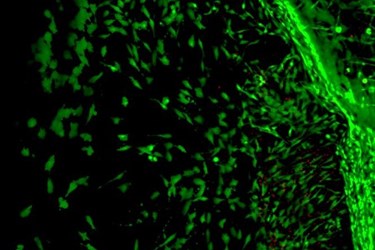
Martin’s team identified precursor cells in normal cartilage that can mature into new tissue, challenging the commonly held belief that cartilage cannot regenerate itself like other bodily tissues. Furthermore, they developed signaling factors, one of which can attract the precursor cells into the damaged cartilage where they begin to regrow.
In a study published in Arthritis and Rhematology, the researchers loaded these signaling factors and growth factors into a hydrogel that was then injected into an experimental model of cartilage damage. By staging the release of the factors, the team was able to first attract the precursor cells and then stimulate their growth.
Researchers then performed a series of push-out tests and compression tests that determined the strength of the newly grown cartilage. While not as mechanically strong as normal adult cartilage, scientists believe that physical therapy might be able to improve its structural integrity.
“This process gives us a great result,” said Yin Yu, lead author of the study. “The new cartilage integrates seamlessly with the undamaged tissue. It has normal concentrations of proteoglycans, good structural properties, and looks like normal cartilage.”
According to Yu, all of the components of the injectable gel are FDA approved for human use, and he is already at work developing a business model for the eventual commercialization of the gel. The team plans to begin animal trials within a year and human trials within five years.
Image credit: UI Health Care