
Built-In Monitoring and Management Reduces System Hardware and Integration Costs
By Jay Shumaker, Project Team Leader, Tracewell Systems Inc.
Design Cost Tradeoffs
Design of a Level 3 CMM System
Outsourcing CMM
Chassis monitoring and management (CMM) functions are critical in many types of systems, particularly those involving high value-added processes where reliability and personnel safety are paramount. To effectively support reliability and safety, it is important to not only know the status of the system devices, but also the total environment in which they operate. CMM provides this feedback by continuously logging data on variables such as temperature, humidity, cooling, power performance, and other diagnostic information. When supplied as part of a system's electronic packaging hardware and software development costs can be substantially reduced. An example is given later in which software development costs were reduced by more than 75%.
Sophisticated equipment typically contains several complex subsystems, all of which must interact not only between themselves, but also with other external systems. Although current technology provides process control and feedback of these subsystems, the ability to monitor and diagnose CMM variables between these sub-systems through a central, integrating host is lacking.
Another problem that complicates monitoring is the diversity of technologies used within many types of systems, particularly those designed for factory- and process-floor applications. Often, these have progressed from strictly PLC-based subsystems to also incorporate PCI, digital signal processing and other proprietary monitoring and control elements. Additionally, subsystems, sensors, and monitored variables are dispersed throughout the larger system, making them inherently difficult to monitor and control through a single source.
In VME and PCI card-based systems, CMM functions are often integrated within the electronic packaging. They let the user know, for example, when there are problems with power supplies and cooling fans, and often allow remote management of these system functions. More recently, CMM functions in these systems have been expanded to include variables outside the electronics packaging, such as those associated with the system environment and electromechanical assemblies. Also, modern networking technology is being employed to bring together data from different subsystems and technologies. These developments make CMM a valuable addition to many types of automation equipment.
Depending on application requirements, there are at least three different levels or types of CMM functions that should be considered:
- Level 1—Simple monitoring only (typically, voltages, temperatures, and cooling fan operation, with local LED indication of failure).
- Level 2—Microcontroller-based monitoring (voltage, fans, temperature, and power supply status monitoring with remote access to status; also remote management features such as: power on/off and reset).
- Level 3—Microprocessor-based, Web-enabled, real-time operating systems (adds advanced platform-independent features, such as remote access via Web browser to configure the system, access log files, and collect general diagnostic data).
Because CMM functions are not a central part of most systems, they are frequently treated as an afterthought. However, thinking about them early in your design cycle allows the most cost-effective make/buy decisions involving criteria such as hardware purchases, programming, system integration, space efficiency, and future expansions or modifications. Before specifying and launching a CMM design, it is best to check features available from your system packaging supplier. You may get more of these functions at a lower cost than taking the do-it-yourself route. This can put more profit on the bottom line and also get your product to market much faster.
Design Cost Tradeoffs
A key design issue in CMM is where to draw the line between functions included in your main system boards and those supplied with the packaging system, or as a separate module. It is almost a given that today's packaging systems are supplied with modular plug-in power supplies and cooling fans, often with n + 1 redundancy. Also typical in these designs is local monitoring of all power supply voltages, chassis temperature and fan operation. However, the environment that many systems operate in suggests the need for remote monitoring and control of these functions, plus additional data collection for diagnostics.
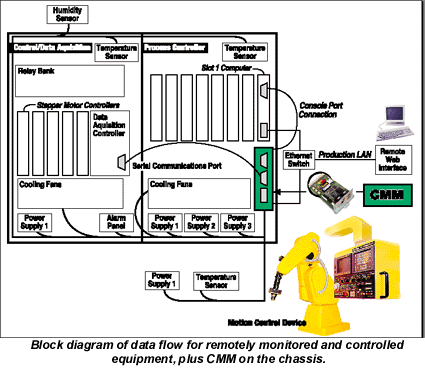
For example, consider equipment that is remotely monitored and controlled through electronics installed in a local system chassis. A block diagram for such a system is shown in Figure 1. However, automatic equipment requires not only control but also diagnostics that provide early warning of impending failures, and data that directs technicians to the failure point when one occurs.
Historically, these troubleshooting functions have been accomplished by technicians manually collecting data from a diagnostic port on the equipment. However, your packaging vendor may be able to suggest CMM functions that eliminate or reduce manual methods of local diagnostics. For example, a high-performance inspection system developer initially purchased a bare-bones VME64 chassis and then designed in Level 2 monitoring of the type described earlier. This required the integration of a half-dozen different hardware modules, including relay boards and Ethernet-to-RS-232 adapters, plus associated software development.
When Tracewell Systems, an electronic packaging system manufacturer, was approached about supplying these functions on the system chassis, their designers pointed out the benefits of Level 3 CMM. For a relatively small cost premium, they were able to provide remote, bi-directional monitoring and control from external PCs and work stations interconnected on a LAN/WAN network by using web browser technology.
Such a system can be interfaced to either PLC- or PC-controlled equipment and facilitates integration of other technologies. It also provides near-real-time machine diagnostics. Level 3 CMM possibilities include:
- Monitoring Functions
- All power supply voltages
- Cooling fan air flow or RPMs
- Multiple chassis temperatures
- Humidity
- High water alarm
- Chassis intrusion
- Management Functions
- Power cycle control of remote equipment
- Download CMM log files
- Console port access of remote equipment
- Upload configuration changes (operating parameters, alarm thresholds, etc.)
- Change network/IP address of the chassis
- Record and/or route diagnostic data from machines being controlled
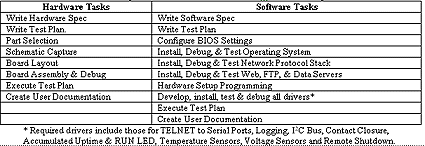
Off-loading CMM functions to the system chassis lets the developer concentrate on core tasks associated with main system functions. With only local monitoring of chassis variables, perhaps this isn't a big deal. However, remote CMM via web browsers adds considerable complexity. Table 1 lists development tasks associated with Level 3 CMM, which illustrates this point:
Design of a Level 3 CMM System
The design of a typical Tracewell Level 3 CMM system can be implemented as an integral part of the electronic system packaging, or supplied as a separate module to be installed elsewhere in the OEM's system. When installed as part of the system packaging, it typically is implemented on one or more boards that reside outside the system bus slots, but adjacent to the main system's single board computer, as shown in Figure 1.
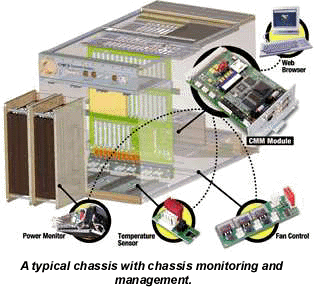
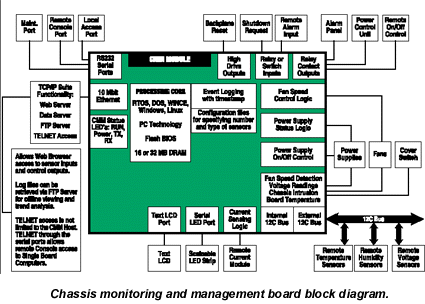
A photo of a typical bare chassis in which these boards would reside is depicted in Figure 2. The functions included in the CMM module depend on application requirements, but a block diagram of a typical module is shown in Figure 3.
For example, the main system's single board computer could act as a host controller. This board might provide analog and digital I/O functions, digital signal processing, local memory, and processing of a control algorithm. In a typical system, this controller would interface with other boards, such as those providing motion control functions.
At the IC level, the CMM module uses devices with the Inter-IC (I2C) bus interface, which facilitates interconnection of a wide array of ICs providing microcontroller and peripheral controller functions. The I²C bus provides data transfer efficiency through a simple protocol format and bi-directional 2-wire design, which consists of a serial data line (SDA) and serial clock line (SCL). Multiple masters and slaves are allowed, because the I²C bus arbitration procedure decides which master gets priority.
This simplicity allows design flexibility while reducing pin count, interconnection costs, and board space. Several "smart sensors" with the I2C interface are available from National Semiconductor, Dallas Semiconductor and other manufacturers, which are designed specifically to monitor temperature, fan speed, chassis intrusion, and power supply failure. Multiple devices can be daisy chained on the I2C bus up to a maximum determined by allowable capacitance on the lines, 400 pF, and the protocol's addressing limit of 16k. (Typical device capacitance is about 10 pF.)
At the networking level, an interface to external PCs and workstations is provided through a web server embedded in the CMM module. The server, along with configuration files, data files, etc. are stored on the board's solid-state disk storage device. Data transfers between external devices (outside the system chassis) and the module take place over an appropriate data communications interface (Ethernet, RS-232, etc.). When FTP transfers are used, they go through the CMM module. A Telnet connection can be made to the CMM module, or through that module to the console port of remote equipment. (However, Telnet does not support file transfers.)
Outsourcing CMM
To get the maximum benefits from outsourcing CMM, design and purchase specifications should be flexible, as well as the initial design review process. For CMM to be most effective, it is important that the system engineer fully understand the environment in which the end product will be deployed. This includes potential hazards and failure modes to help determine the elements that must be monitored and define user interface requirements. Communicating this information to system packaging designers will help them determine the appropriate level of CMM and specific features required for the application.
In the case of the inspection system developer mentioned earlier, by switching to a packaging system with built-in Level 3 CMM functions, many of the earlier integration costs were eliminated. For example, software development for this OEM was reduced by more than 75%. This was accomplished through the use of an open-standard software architecture that can be easily adapted for each application. Also, since the Web server is embedded in the CMM controller, associated software development is limited to that module—no proprietary interface software is required.
Moreover, it was easy to tie the resulting system into the firm's overall inspection monitoring scheme. The Level 3 CMM controller works with individual IP addresses that are unique for each user and inspection system chassis, allowing multiple access anywhere on the network.
Physically, all primary CMM control was implemented on a single 3U x 160mm board, with onboard Ethernet and RS-232 communication. This board also provides remote sensor control through a simple I2C two-wire bus that drastically reduced hardware integration complexity. The hardware costs of adding the entire Level 3 CMM was roughly the same as the Ethernet to RS-232 adapter alone in the original solution.
Since the Level 3 CMM controller has its own independent microprocessor, it is able to communicate directly with the system CPU console. It also provides this access to remote users, such as service personnel, over a LAN/WAN connection. This allows the user to view diagnostic information and make configuration changes to the CPU operating system and BIOS independent of the CPU network interface.
This system also supplies a high degree of flexibility. The CMM controller's open-standard operating system allows fast upgrades to change controller parameters, such as alarm settings, logic states, and additional sensor devices. Since the interface to the CMM is through a standard Web browser, no field software changes are required to make these modifications. A system administrator simply changes the web page configuration directly on the CMM controller and remote users are automatically updated.
Jay Shumaker is a Project Team Leader for electronic packaging systems at Tracewell Systems Inc. in Westerville, Ohio. He has more than 10 years of experience designing microprocessor and microcontroller boards, and the enclosures in which they are installed, particularly for data communication applications. He can be reached by email at jshumaker@tracewell.com, or by phone at 614-846-6175.
Source: Electronic Engineering.com, sister website to Medical Design Online.