
Immersion Medical Offers Cardiac Surgical Simulator Module For Coronary Valve Replacement
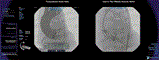
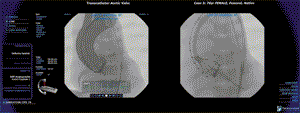 San Jose, CA - Immersion Corporation, a leading developer and licensor of touch feedback technology, recently announced that Immersion Medical has launched a new module for its CathLabVR Surgical Simulator. The new Transcatheter Aortic Valve module helps train physicians for minimally invasive coronary valve replacement.
An estimated 450,000 patients in the U.S. suffer from severe stenosis (narrowing) of coronary valves, which impedes blood flow and can lead to heart failure. More than half of the patients affected in the U.S. are over 75, an age group expected to increase in the coming years. The medical needs of many patients with severe aortic stenosis have been unmet. Patients may exhibit few symptoms until an abrupt change occurs, and surgeons and patients are less likely to opt for invasive surgery to treat stenosis that is not pronounced, a situation that can lead to life threatening symptoms or death. Even when stenosis is known to be severe, open heart surgery may not be possible if the patient's health is compromised in other ways. Minimally invasive valve replacements can provide a safer alternative to open-heart surgery with shorter procedure and recovery times. It is likely that with a less invasive treatment more patients could and would be treated. Therefore, valve replacement interventions are seen by many as the future standard of care for many high risk patients. With its realistic surgical simulations, Immersion Medical's new cardiac surgical simulation module can help accelerate learning and adoption of these minimally invasive life-saving procedures.
"The CathLabVR Surgical Simulator's cardiac surgery module was created to keep pace with advancements in technologies and techniques," said Kevin Kunkler, M.D., vice president, and medical director of Immersion Medical. "The module helps doctors-in-training to learn the core concepts of these procedures and surgeons and interventionalists to master the necessary steps and gain experience and knowledge transferable to real-life cases."
With eight cases that provide experience with four anatomies, the Transcatheter Aortic Valve surgical simulation module provides practice in:
- Navigation through either the femoral artery or through the apex of the left ventricle
- Balloon inflation to pre-dilate the aortic valve
- Use of fluoroscopy, cineangiography, and contrast injection to visualize and measure the aortic valve and determine a site for its correct placement
The CathLabVR Surgical Simulator uses actual diagnostic and therapeutic devices, such as catheters, balloons, stents, and distal protection devices. A procedural-based system, it allows trainees to practice and repeat cases of varying levels of difficulty and to experience and manage complications. The system's appropriately responsive physiology is reflected in vital-sign changes, hemodynamic wave tracings, and patient audio responses that enhance the decision-making process. An added benefit is the realistic haptic feedback that mimics the feel of the procedure. Visual aides, including the virtual 3D anatomy model and live fluoroscopy, help trainees understand vascular anatomy and device operation. A comprehensive performance report, automatically generated after completion of the surgical simulation, allows objective assessment of the user.
The CathLabVR Surgical Simulator provides a realistic training environment to help practicing physicians safely train in new procedures to keep pace with medical innovations. The system can also help prepare fellows to meet the requirements of the Accreditation Council for Graduate Medical Education (ACGME), which call for a minimum of 300 cardiac catheterizations before training in coronary interventions, followed by a minimum of 12 months and at least 250 interventions.
SOURCE: Immersion Corporation