
New form of rapid prototyping makes models from ice
According to the developer of the new system, Ming Leu, a professor in Missouri's department of mechanical and aerospace engineering, conventional rapid prototyping, which was developed in the 1980s, uses equipment that is too costly and generates dust or smoke that poses health hazards. Because the new system is based on ordinary water, he reasons that it should be cheaper than polymer-based counterparts as well as free of fumes.
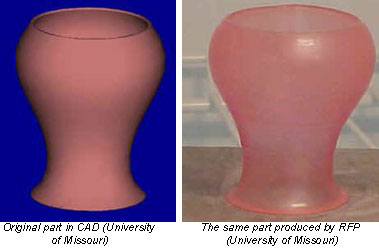
The new technology, which Leu has dubbed Rapid Freeze Prototyping (RFP), works in a fashion similar to other rapid prototyping techniques. In his facility at Missouri's Engineering Research Laboratory, Leu has built an experimental system through which droplets of water are deposited from a nozzle onto a surface, just as the plastic material of other systems. Unlike other rapid prototyping techniques, however, this one occurs within a freezing chamber, to keep the fabricated part intact. Moreover, rather than creating the prototype layer by layer, Leu's system first creates a frozen "shell," or boundary, out of ice, then fills the enclosed interior with a steady stream of water that freezes. Creating the boundary first, then filling it, considerably reduces the time involved, Leu says.
Leu concedes that his system is still very experimental. But he believes it offers manufacturers a variety of advantages to traditional prototyping systems. Aside from its speed and lower operating costs, he asserts, the system also would make it easier for manufacturers to build transparent parts, as well as color parts (just add food coloring to the water stream).
For more information, contact Andrew Careaga, University of Missouri, Rolla, at 573-341-4328.
Edited by Gordon Graff
Managing Editor, Laboratory Network.com