
New Marking Technique Makes for Fast, Positive Device Identification
Data Matrix Code Aids Manufacturing, Packaging Processes
The significant and potentially costly problem of accurately identifying size and orientation of artificial joints can now be eliminated. By using an inexpensive new technology that automatically illuminates and reads two-dimensional codes directly marked on parts, Howmedica Osteonics (Allendale, NJ), a division of Stryker, is able to positively identify parts. Previously, the company had to rely on costly three-dimensional vision technology to make sure the correct part was matched to its paperwork and packaging.
"We needed an electronic identifying mark on the product, and we needed to eliminate manual entry of information in manufacturing. Now, we mark the parts. Once the mark is on the parts, we can identify them anywhere in the plant. It should eliminate any error," says Meg Smith, manufacturing cell manager.
Two-dimensional scanning is less than one-third the cost of vision systems doing optical character recognition or optical character verification. Marking the 2-D codes directly onto the part early in the manufacturing process not only helps ensure accurate packaging, but facilitates better manufacturing. This method gives error-proof identification for a fraction of the cost of an imaging system. It is also faster and is less susceptible to error than traditional methods that require a high level of human intervention.
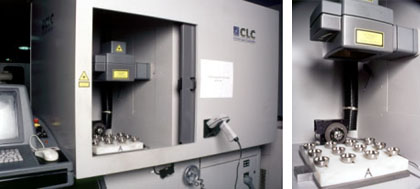
A CNC laser machine etches two-dimensional codes directly onto the artificial joints.
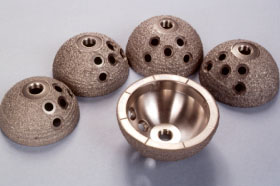
The artificial joints showing the etched-on two-dimensional codes.
Data Matrix Code Etched On
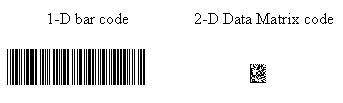
The heart of the technique is a tiny, two-dimensional Data Matrix code applied directly to the part during the manufacturing process. Two-dimensional symbologies permit a significant amount of data to be packed into a very small space, currently less than one-tenth of an inch square. Matrix code comprises uniformly sized data cells placed on a square field. Data Matrix code can contain up to 100 times the amount of data, or track the same data using only two percent of the labeling area, of a traditional bar code. The code in essence is a tiny database that becomes an integral part of the item by being marked or etched onto the item surface. The Data Matrix code as shown below is a far more compact and versatile option for automatic data collection applications than the standard barcode (see illustration). Once marked, the symbol is then verified for consistent readability, and then read at critical points in the manufacturing process and just prior to packaging.
Reading is accomplished through the use of digital CCD (charge-coupled device) scanners. Reading a code typically requires high contrast between the cells and spaces on the field. But by using CCD scanners fitted with a sophisticated new lighting product called the LytePype, the mark can be illuminated to create contrast even on white polyethylene. The LytePype controls direction of light from the source to enhance the contrast of the mark on the subject. It optimizes illumination angles and shields the surface from extraneous, uncontrolled light to read the low-contrast directly marked images. This lighting is adaptable to both fixed position and handheld readers. The CCD scanners, verifier and LytePype lighting source are from Auto Image ID (Cherry Hill, NJ). The company designs and manufactures real-time image recognition systems used in automatic data collection (ADC) for industrial applications.
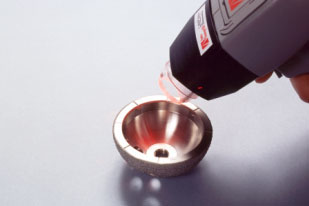
A CCD scanner reads the Data Matrix code etched on an artificial joint.
"We needed a solution that did not add to manufacturing costs or labor requirements. By using the mark in manufacturing, we eliminated redundant manual data entry. By using the mark in the packaging process, we cut some of the labor-intensive work there as well. We're doing something that no one else has done before," says Smith.
"We were trail-blazing then. We worked with them to establish marking parameters for each surface they were going to etch to ensure symbol quality," explains Dave Bubnoski, vice president of engineering for Auto Image ID. "It took a few weeks to get the settings established. Now, they can mark a variety of surfaces with turn-key settings."
Time, Expense Offset by Savings
The time it takes to mark each part is more than off-set by time saved through elimination of manual entry of information needed for manufacturing, and manual verification that parts, paperwork and packaging match. Part information is contained on the manufacturing work order. The part number and case code are converted into a Data Matrix code, and then the code is converted into machine language so a CNC machine can laser etch the mark onto titanium or cobalt chromium parts. The company is currently working to dot peen Data Matrix code into polyethylene.
Smith reports, "Data Matrix is the solution to the problem of identifying parts. We can identify the part based on what it is, not based on what any piece of paper says it is."
For more information: Howmetica Osteonics, 59 State Rt. 17 S, Allendale, NJ 07401-1677. Tel: 201-825-4900. Fax: 201-507-7830.
Auto Image ID, 2 Keystone Ave., Bldg. 43, Cherry Hill, NJ 08033. Tel: 856-424-5599. Fax: 856-424-4788.