
Imaging Bio-Engineered Tissues In Real-Time
By Chuck Seegert, Ph.D.
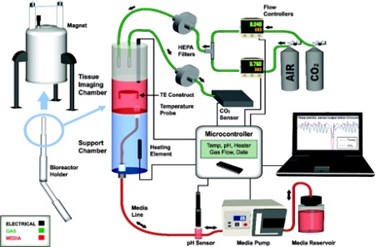
Studying the real-time development of cell growth on a tissue-engineered scaffold is now possible with a new magnetic resonance imaging (MRI)-compatible bioreactor. The device could potentially help researchers test engineered tissues prior to transplantation, improve the success rate of transplant procedures, and help researchers bring experimental tissue engineering methods to real-world applications faster.
Using cell-based tissue engineering techniques requires the ex-vivo growth of cells on scaffolds. Generally, proper cell density must be achieved prior to using the tissue for human implantation, but knowing if the scaffold had proper cell growth wasn’t possible until now. Being able to understand the level of cell growth prior to implantation would increase likelihoods of success in procedures like these. Additionally, having insight into the intermediate growth steps and characterizing those steps would help the understanding of tissue engineering in general.
To meet these goals, a research team at the University of Nebraska has developed what they call an e-incubator, according to a recent press release. The e-incubator acts in a standalone fashion and is automated to detect and control temperature, carbon dioxide levels, and pH using an internal microcontroller.
"Calibratable, hands-free tissue development environments are becoming increasingly important for the engineering of implantable tissues," said Tissue Engineering co-editor-in-chief Peter C. Johnson, M.D., in the press release. "In this new development, noninvasive imaging modalities are added to the spectrum of sensing and environmental capabilities that heretofore have included temperature, humidity, light, physical force, and electromagnetism. This represents a solid advance for the field."
The system was validated using tissue-engineered bone constructs that were cultured in an incubator for 4 weeks, according to a study published by the team in Tissue Engineering Part C. The imaging of these cultured constructs enables temporal and spatial understanding of the cell growth environment, which can allow the disposal of constructs that aren’t sustaining good cell growth. This promises to be especially important as construct design increases in complexity.
Advances in tissue engineering that could benefit from the e-incubator are many. One possibility may include brain models that are cultured for months at a time, as was recently reported on by Med Device Online.
Image Credit: Tissue Engineering Part C: Methods